
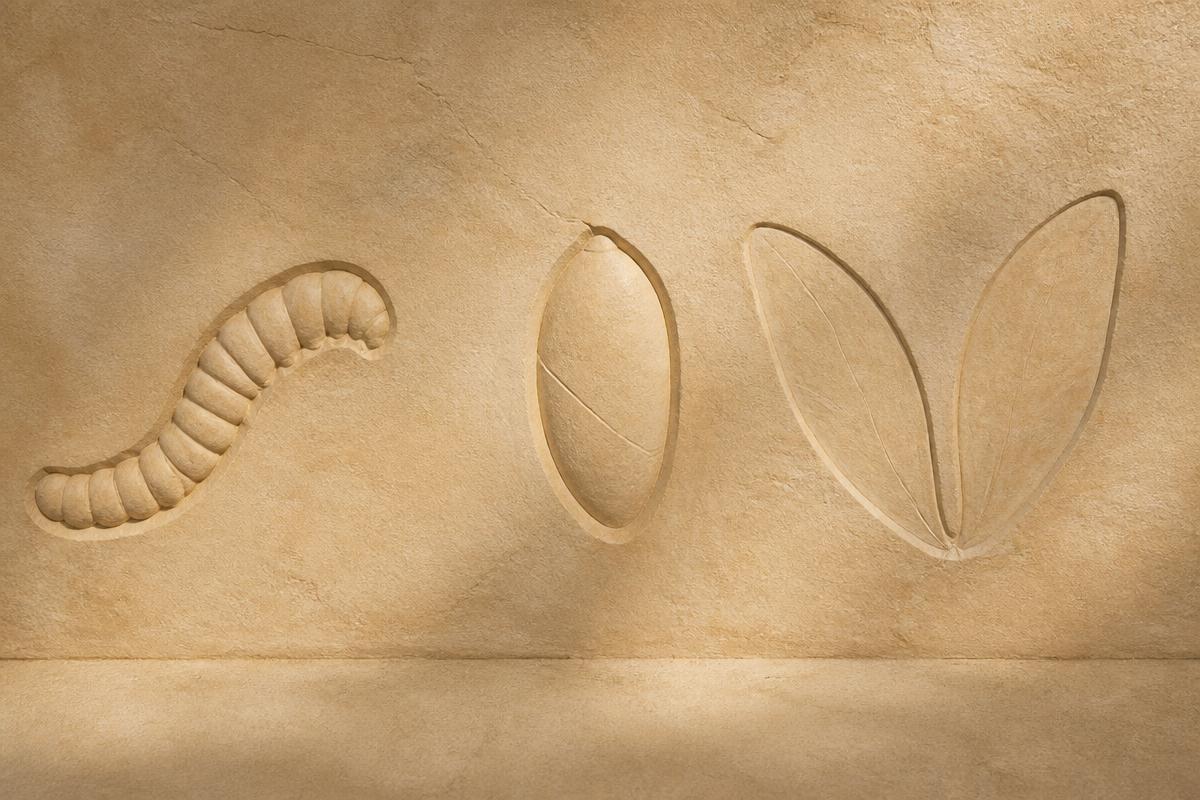
A caterpillar does not decide, one morning, to become a butterfly. Long before the chrysalis forms, its body is already carrying small clusters of cells called imaginal discs, holding the blueprint of wings and antennae it has never used and does not yet need. For most of the caterpillar's life these cells lie dormant, doing nothing that can be seen from the outside. When the old body finally dissolves inside the chrysalis, nothing new is being built from scratch. What was quietly present the entire time is simply being released.
Unmukt has a similar history. The name is new. What it names is not.
Before Unmukt, there was SKC
In 1999, Sameer Kamboj founded SKC World with a question most enterprises are not built to ask: who is the person building success? Not what someone had built, but what was building through them: fear of not having enough, a need to prove something to someone who may no longer be watching, or something closer to freedom.
Shalini Kamboj co-founded the work and brought a quality it still depends on. Where Sameer's directness confronts a person with the question, Shalini's presence holds space for it, long enough for someone to arrive at their own answer. Together they wrote The Possibilities of Potential, whose intention sat in a single disarming line: the book does not provide answers, it makes you question. That sentence, more than any tagline that came later, was the imaginal disc.
For twenty five years SKC World moved slowly and deliberately, on purpose, with no funnels, no targets, no deadlines, yet thousands of entrepreneurs passed through these rooms, one leader at a time. Across the Conscious Entrepreneurship Program, the Envisioning Workshop, Essentials of Success and Anaavaran, many came for clarity on a business decision and left with their purpose; some came skeptical and stayed for years; some came to ease their pain and found liberation. The thread connecting every one of those conversations was never named out loud in the early years. It only needed to be practiced, patiently, long enough to become undeniable.
What Keeps Showing Up in Every Room
Every person carries what we call the Core, the true Self, steady beneath everything we do. Mind, body, intellect and energy are the faculties through which it engages with the world. Identity begins when we mistake one of these, or the story built around it, for who we truly are: generous, sharp, successful, spiritual, or someone who never tries. Once formed, it seeks validation and treats any challenge as a threat.
Across twenty-five years of sitting with founders and CXOs, the same four responses kept appearing: Denial. Justification. Escape. Aggression.
Aggression may turn outward as anger, or inward as resentment. The setting may change, from a boardroom to a family dinner, but the mechanism stays remarkably similar. Psychology and neuroscience have mapped parts of this territory: defense mechanisms, cognitive dissonance, the narrative self. The inquiry at Unmukt goes somewhere different.
Not: How do we build a healthier identity?But: What remains when the one constructing the identity is directly known?Even “I'm OK, you're OK” can become another identity to protect. The exit is not in perfecting the identity, but in knowing the Core clearly enough that identity becomes an instrument again, rather than something we mistake for who we are.
Carrying the Work Forward
Twenty-five years produces more than a body of work. It produces people who have lived it deeply enough to carry it forward. Seven such people stand at the heart of Unmukt today. They came to this work already accomplished, having built enterprises, led organizations and shaped capital, culture and brands. Yet success had not answered the questions beneath their success. Each chose to stop and look deeper. Over time, they moved from participants to practitioners, and eventually to carriers of the work in their own right.
Abhishek Goel, Iram Rizvi, Ruchi Sharma, Anirudh Birla and Jaisika Jabbal, alongside two others whose names will be shared in time, bring distinct life experiences, perspectives and capabilities to Unmukt. What unites them is not a role or title, but years of inner work and a shared commitment to take what they have experienced into the world. Together, they have helped evolve Unmukt from the insight of its original founders into a living body of work that can travel across people, generations and contexts.
And the circle is growing. Eleven more are currently immersed in the same rigorous inner journey, preparing to carry the work further in their own voices and into horizons its founders may never personally see. This is how the work continues. Not through followers, but through people who experience it, embody it, and eventually make it their own.
Why the Name Finally Arrived
By early 2026, this understanding had been tested across three decades, thousands of conversations, and enough founders willing to be honestly seen that it no longer needed proving. What it needed was a name that reflected what it had become, rather than what it had once been called. This was not a rebrand. A realization finds its true name only once it has been lived. Siddhartha did not call himself the Buddha, the awakened one, before the awakening, but after.
Unmukt, उन्मुक्त, means absolute liberation while fully alive. Not liberation as an afterlife promise. Not liberation as an escape from life, but the freedom to engage with it fully. The name had always existed. The work had finally grown into it.
Today, that work has taken many forms. Conscious Entrepreneurship, when it meets the choices and realities of building a business. The Unmukt Fund, when it meets capital, backing founders who build from completeness rather than hunger. The Unmukt Campus, when it meets land and creates a place to gather, experience and explore. The Unmukt Dialogues, from New York and the Bay Area to Boston, when it meets rooms of people willing to sit with questions that matter. These are not separate initiatives. They are different expressions of the same twenty-five-year-old realization, finally taking shape in the world.
Why Unmukt, now
skc.world carried this work quietly for many years, as it found its shape. Unmukt.com marks a moment when the container needed to grow with what it holds. Not a rebrand, but a more honest expression of what this work has become.
If you have found your way here, you may be a founder sensing a gap between the life you have built and the life you experience. You may be family, a friend, an investor, or simply someone following a question that would not let you go. Different reasons. The same door. Come through whichever one brought you here.
Unmukt offers no new identity to adopt, no new version of yourself to become. From the first conversation in 1999 to this page today, the direction has remained the same: to know yourself clearly enough to live with one identity less.